
We use cookies on this site to enhance your experience.
By selecting “Accept” and continuing to use this website, you consent to the use of cookies.
The future is golden for students in Laurier’s Capstone Urban Sustainability Project (CUSP) course – and for the City of Cambridge, ON.
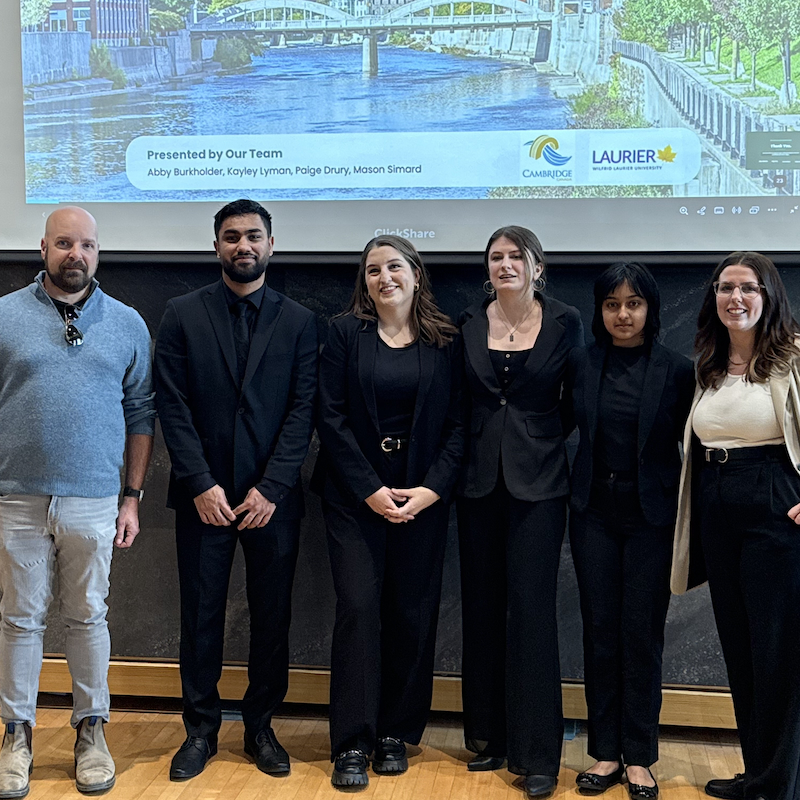
CUSP is a full-year course that provides Geography and Environmental Studies students with true-to-life experience in urban planning and consulting. Students are placed into groups that act as planning consultants, responding to requests for proposals from the city of Cambridge, engaging in the community, conducting research and presenting their final recommendations to Laurier faculty, industry professionals and local politicians in Cambridge.
In March, each consulting group from the 2025/26 class presented a different vision for GALT 2075, this year's theme: Urban Axis Consulting proposed a combined active and public transportation loop around the downtown core; Pike Partnerships proposed expanding parks along the Grand River to mitigate flood risk to heritage buildings; Solaire Solutions proposed a luxurious, sustainably built multi-use development that promotes Galt as a cultural destination; and EnviroMotion proposed repurposing parking lots into accessible park space that creates a walkable city centre.
“CUSP’s experiential learning model sparked my interest in urban planning and design, and ultimately led me to choose a graduate degree program in planning,” says Lydia Serbanescu (BA ’26), whose consulting group Urban Axis Consulting won the Paul and Louise Puopolo Urban Initiatives Award for their capstone project. “We don’t often receive the opportunity to act as professionals in fields we may pursue after graduation, and it’s an incredible way of assisting us in discovering future career paths.”
Now wrapping up its eleventh year, CUSP is made possible by an active three-way partnership with Laurier’s Geography and Environmental Studies department, the City of Cambridge and Polocorp, an integrated land development and planning consultancy founded in 1978 and committed to building sustainable communities while protecting and enhancing local heritage throughout Waterloo Region.
“The capstone program was really only successful because it was a joint venture with Laurier, the private sector and the City of Cambridge,” says CUSP co-founder Paul Puopolo (BA ’73), who became president of Polocorp in 2013 and now serves as the company’s chairman and senior counsellor. “That involvement with the community was very important in developing the program. It gives students the opportunity to participate in real projects in community development at the local level.”
Everyone benefits from this model. Geography and Environmental Studies students gain professional contacts and real-world experience that sets them up for successful urban planning careers; the City of Cambridge benefits from students’ big-picture perspective on complex issues facing the community; and Polocorp can help inspire a passion for community-building among the next generation of planners and city-builders.
CUSP officially launched in September 2014, but the idea came two years earlier, at an event celebrating the 50th anniversary of Laurier’s Geography and Environmental Studies department. Now retired, Bob Sharpe is a former associate professor in the department, and taught CUSP in its early years.
“We brought in a large group of faculty and former students, and at the end we asked what they thought should be the vision of the department,” Sharpe says. “The resounding response was more community engagement. Get the students involved in experiential learning with real-world projects.”
Puopolo remembers speaking at the event as an alumnus and former sessional lecturer in Urban Studies.
“Laurier had a major impact on my career and in my life’s choices,” he says. “When I graduated in 1973, I was involved with Laurier on some real-life projects that had an impact on the City of Waterloo.”
The experience was inspirational, and Puopolo urged Sharpe to provide more opportunities for students to participate in real projects whose impact they can see in the world around them.
For Sharpe, that means going beyond theoretical knowledge and talking to members of the community you serve, often literally walking the streets to experience the living environment of a city. With the City of Cambridge as a partner, students can study real-life data and talk to members of the community their projects will impact.
“The City of Cambridge is proud to partner with the CUSP capstone course,” says Brynn Nheiley, director of planning and CUSP classroom partner at the city. “As students learn urban planning skills through focused research and community engagement, they can help city planners better understand and engage with residents at the neighbourhood level.”
While Puopolo and Sharpe have largely passed the torch, the CUSP partners continue their commitment to providing an education that’s as true to the urban planning experience as possible.
Polocorp and the City of Cambridge both provide operating support for the capstone course and continue to mentor students throughout the year. To promote some friendly competition among the student consulting groups, Polocorp donates additional funding to award as prizes at the end of the course. Prize-winners are decided by an adjudication committee made up of Laurier faculty and representatives from Polocorp and the City of Cambridge.
CUSP is now taught by Laine Young (PhD ’25), Sharpe’s former teaching assistant who took over in 2018.
Rather than setting up the course as a series of lectures, Young says CUSP is structured around skill-building workshops and guest speakers, including representatives from the university, the City of Cambridge, Polocorp and Laurier alumni. She meets with Cambridge city planners every summer to collaborate on a theme for the year and create a request for proposals (RFP) that students will respond to as planning consultants.
Joseph Puopolo (MBA ’03), Paul’s son and now co-CEO of Polocorp with his brother Mike, has helped strengthen the partnership between the university, the City and the private sector that has made CUSP a model for experiential learning. Through mentorship, industry engagement and ongoing support for the program, he works to ensure students gain exposure to the practical realities of planning, development and community-building.
“Experiences like CUSP are invaluable because they give students the opportunity to work on real challenges facing our communities, while developing the practical skills they’ll need throughout their careers,” he says. “For Polocorp, supporting this capstone course is a natural extension of our commitment to community-building. CUSP allows students to bring fresh thinking to complex issues and develop solutions that can help shape stronger, more sustainable communities.”
Taking the long view provides another benefit for Cambridge.
“City planners can only really plan ten years in advance, so this is a visioning exercise that they normally wouldn’t be recommended to do,” Young says. “They appreciate when the students come in and they can think as big as a student would.”
Once the year’s theme has been decided, the CUSP class spends the fall semester creating their consulting groups and developing proposals. The class size is small, with a maximum of 25 students to ensure that each team and each individual can access the resources and develop the skills they would need to embark on a successful career in urban planning.
“At the beginning of the semester we do a lot of group formation activities, such as self-assessments on students’ strengths,” Young says. “Then I have a giant spreadsheet where I spend a lot of time putting together their groups based on those strengths.”
Young ensures each group has the complete skillset needed to complete the capstone project, including project management and leadership, graphic design, policy research and Geographic Information Systems (GIS) mapping skills. The students then create consulting companies with a name, brand identity and logo, and assign roles within the group on their own.
“It’s like a resume builder in a lot of ways,” she says. “So many of our students have gone on to earn master’s degrees in planning, or gone out into the workforce to do relevant urban planning and sustainability- and environmental-focused positions that they feel are made possible because of the skills they gained in this course.”
For Joseph Puopolo, CUSP brings benefits to his own community.
“As a Laurier graduate myself, it’s very gratifying to see the next generation of planners learn, take practical information and come up with ideas that could be implemented in the real world,” he says. “And if some of these ideas can create a better environment within the City of Cambridge, so much the better. As a resident of Cambridge, I will only benefit from it.”
Sharpe says that CUSP’s commitment to real-world experiential learning has earned the course a reputation for producing excellent urban planners.
“CUSP students are in training to do the real work of planners, assisting the staff and council at the City of Cambridge,” he says. “They’re responding to requests for proposals, putting together the proposal and defending it to staff, making that presentation, honing their skills, presenting complex ideas in 15 minutes or less and then defending that in front of an adjudication committee. Normally that kind of thing only happens at a graduate level, so this really gives them an excellent foundation.”
“Every team demonstrated creativity, rigour and a deep commitment to urban sustainability,” Young says of the 2025/26 cohort. “The ideas, questions and debates that emerged throughout this process are exactly what thoughtful city-building requires, and the future of our cities is better for it.”